Wood-chip boilers
The comfort of wood heating combined with the automation of an oil or gas boiler. The chip boiler delivers high efficiency, automated feed and the ability to use all wood species — provided the chips have a consistent, controlled granulometry.
Wood energy — an ecological and economic choice
Heating with wood has more than one advantage. It is first and foremost a renewable energy that is environmentally respectful: burning wood releases no more CO₂ than the plant absorbed during its growth. It is not a fossil fuel — it does not contribute to the greenhouse effect.
Using wood also encourages the preservation of forests. It has been demonstrated many times over that for a forest to be properly managed, it must also have economic value. Every time wood is replaced by another material, hectares of forest are put at risk.
The main reluctance around traditional wood heating is the number of handling operations involved — splitting, drying, storing, reloading. This is precisely what the automatic chip boiler resolves.
Chipped wood in an automatic boiler
The automatic chip boiler works exactly like an oil boiler: it draws its fuel from a storage silo via an auger system (equivalent to the oil pump), according to the power demand of the heating installation. It regulates its output, switches off and restarts automatically, without any user intervention.
A ventilation system supplies the combustion chamber with exactly the right amount of air, optimising efficiency and limiting particle emissions.
Depending on the silo volume and the season, refilling takes place every three days, weekly, monthly — or even just once per heating season.
Unlike traditional log wood, which rules out certain species, the chip boiler makes use of all wood types, including small branches.
Thanks to the very high combustion efficiency, ash removal is needed at most once a week.
The technology relies on two complementary and essential pieces of equipment: the automatic chip boiler and the branch chipper. It is the combination of these two machines that guarantees the autonomy and comfort of the whole system.
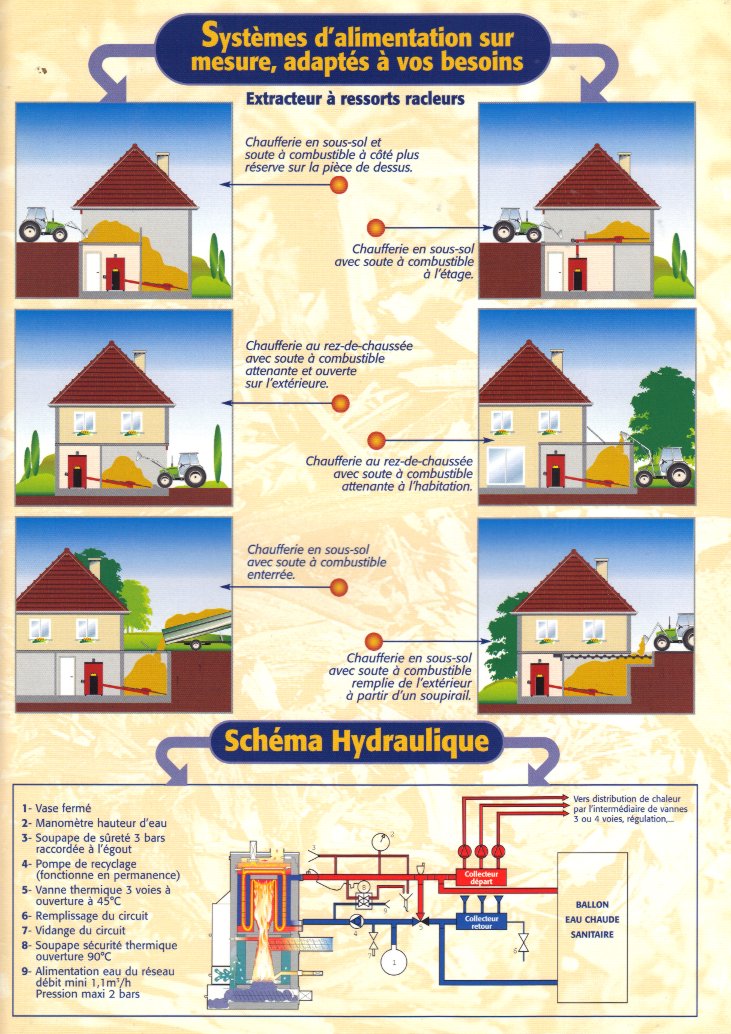
Hydraulic schematic — component detail
- Closed expansion vessel
- Water pressure gauge
- 3-bar safety valve connected to drain
- Circulation pump (runs continuously)
- 3-way thermostatic valve opening at 45 °C
- Circuit isolation valve
- Circuit drain
- Thermal safety valve opening at 90 °C
- Mains water supply — min flow 1.1 m³/h, max pressure 2 bar
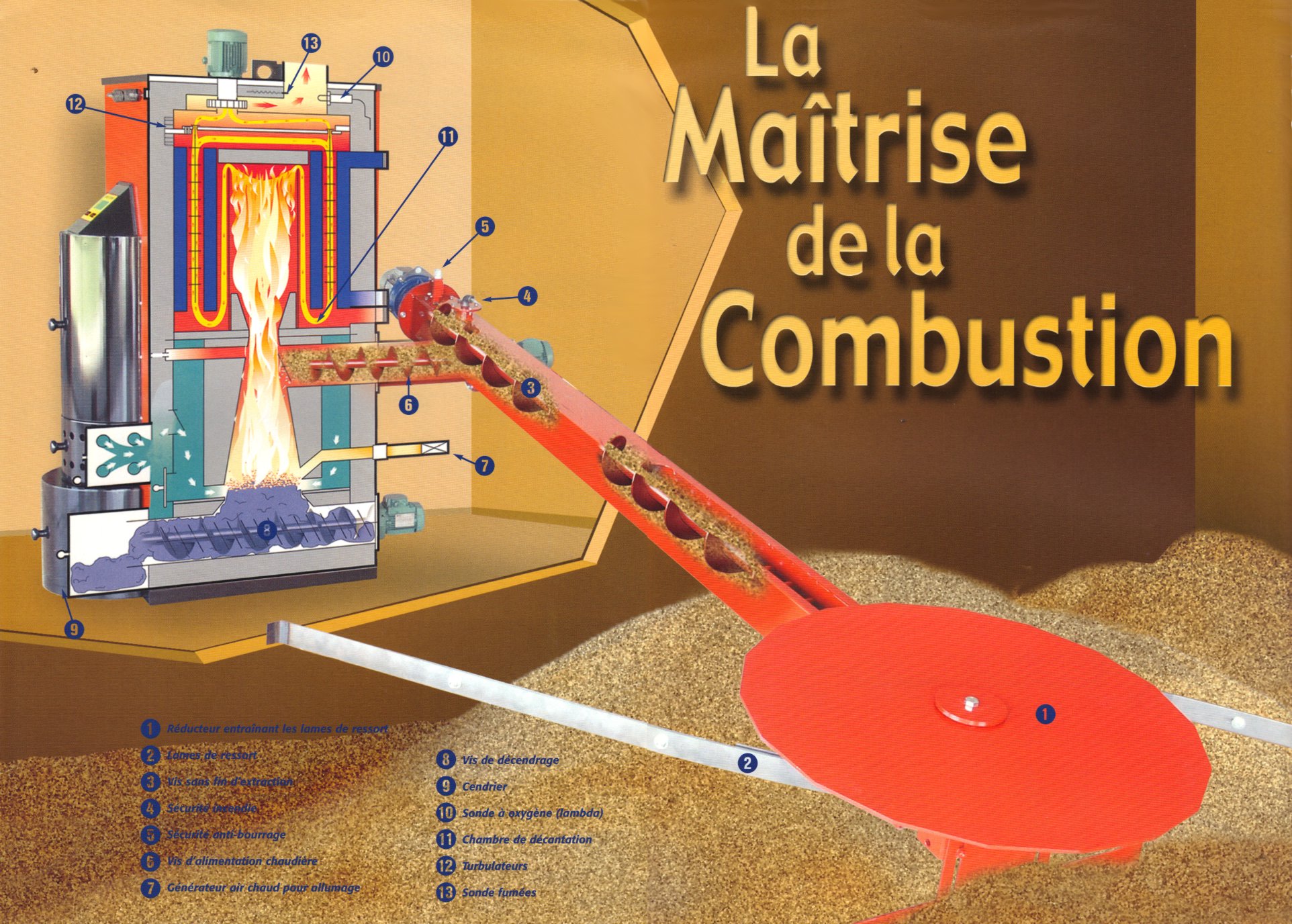
Component detail
- Gearbox driving the spring blades
- Spring blades
- Extraction auger
- Fire safety device
- Anti-jam safety device
- Boiler feed auger
- Hot-air generator for ignition
- De-ashing auger
- Ash drawer
- Oxygen probe (lambda)
- Settling chamber
- Turbulators
- Flue gas probe
Granulometry — the key to reliable operation
The chipper — whether used by a chip fuel producer or for self-supply — must guarantee highly consistent chip quality, free from any large wood fragments that could cause incidents in the boiler's feed system.
Chips that are too long or too thick, or that contain sawdust or large splinters, cause auger jams, leading to premature gearbox wear and excessive energy consumption. They also degrade combustion quality and increase emissions.
Chips must be consistent not only in size, but also in moisture content. Poorly controlled moisture compromises combustion quality, encourages tar build-up in flues and causes problems during silo storage. Chip drying is a key step in the whole process.
Chips or pellets?
Over the past few years, wood pellets have grown as an alternative to chips, for both individual and industrial heating. They are credited with appealing advantages — higher energy density, lower jam risk. But what is the reality?
- Self-production possible — you can produce your own fuel
- Very low raw material cost — makes use of branches and residues
- All species, diameter limited only by chipper model
- Favourable energy balance — simplified process, lower embodied energy
- Consistent granulometry guaranteed — zero large splinters, zero sawdust
- Impossible to self-produce easily — industrial process or costly additional equipment required
- Significantly higher purchase cost (compression, industrial drying)
- Less favourable energy balance (embodied energy of manufacture)
- Higher energy density
- No auger jam risk (standardised format)
Because the majority of chips and chipped wood available on the market do not have consistent granulometry and cause frequent jams in feed augers, and because chip drying is often poorly controlled, this option has gradually fallen out of favour. Pellets work around these problems — but they don't solve them at source and bring their own drawbacks. A Super-Pain chipper solves them directly.
Heating with wood without lighting a fire
While combustion remains the most widespread route for converting wood into thermal energy, Jean Pain developed a radically different technique: recovering the heat generated by the fermentation of chipped brushwood, with no combustion at all. A chip heap in fermentation can maintain a temperature of 35 °C for 18 months — and transforms into a high-value organic soil amendment at the end of the process.
Consistent chips — our speciality since 1981
Our Super-Pain chippers guarantee the ideal granulometry for drying, combustion in automatic boilers and all other wood applications. Built in France, lifetime structural warranty.