Clearance & wildfire prevention
Preventive clearance is one of the few effective actions against large wildfires, but it remains costly and difficult to deploy at scale. The branch chipper changes the equation: by turning clearance residues into a valorisable resource, it makes prevention economically viable — for the private landowner as much as the professional forest manager.
A growing risk
Forest fires are a growing reality in France and across Europe. Under the combined effects of climate change, rural land abandonment and the progressive scrubland encroachment of rural areas, burnt areas are increasing year on year. The summer of 2022 provided a tragic illustration, with over 70,000 hectares burning across France in a matter of weeks.
But what these figures don't reveal is that the vast majority of these fires could have been limited — or even prevented — by regular vegetation management. Dry scrubland is the primary fuel for fires: where the land is maintained, fire spreads more slowly, burns less intensely and is easier to fight. Jean Pain had already observed this in the Var in 1978.
"In March 1978, I was able to confirm this obvious truth on the forestry land I inhabit: we recorded over a hundred fire starts from sparks landing on the very ground of a cleared forestry area, where the fire died out of its own accord for lack of fuel, without the help of any fireman, while all around the fire was raging and would go on to destroy six hundred hectares of forest in a matter of hours."
Preventive clearance is an essential measure, but it does not replace firefighting resources. Water bombers, firefighters, tanker trucks — these remain indispensable. Prevention makes their work more effective: a fire that spreads more slowly is a fire that can be fought.
From waste to resource — the chipper as a lever
Jean Pain had formulated this intuition as early as the 1970s: scrubland is not waste — it is a potential resource. With remarkable foresight for the time, he identified sound clearance as the "radical and only solution to the problem of forest fires" and had already resolved the economic barrier.
"Clearance costs money, ENERGY, until now with no return — a drain on departmental and national budgets. For the first time, through brushwood composting, we can envisage, through the profitability of the organic fertiliser and ENERGY obtained, putting the forests of the French Mediterranean basin from Menton to Biarritz beyond the reach of fire at National scale, at no cost. And at the same time, fertilising and restructuring the poor or catastrophic soils weakened and stripped of HUMUS."
What Jean Pain described as a vision in the 1970s is technically achievable today. The branch chipper turns clearance residues into directly usable chips — wood energy, horticultural mulch, animal bedding, compost. It eliminates disposal costs and creates a saleable resource that can cover part or all of the site cost.
- Residues to remove or burn — additional cost
- Burning often prohibited in summer, the most critical period
- Residues left on site = fresh fuel
- High overall cost, discouraging compliance
- Residues chipped in situ, continuously
- Chips valorisable — energy, mulch, bedding, compost
- Valorisation can cover part or all of the site cost
- Prevention that is economically viable — and therefore actually carried out
From the private landowner to the professional forest manager
The preventive clearance challenge concerns a very wide spectrum of landowners and managers — from the private individual who must maintain the area around their home in a fire-risk zone, to the authority managing thousands of hectares of forest. Our chippers cover the full range.
The Super-Pain 280 (max. Ø 7 cm) or the Super-Pain 450 (max. Ø 12 cm) are sufficient for the vast majority of clearance operations around a residential property. The chips produced can go directly into the garden as mulch or compost. Available in petrol, electric or tractor versions.
The Super-Pain 600 or the Super-Pain 900 are the benchmark models for medium-scale sites. They mount on a tractor or on a trailer with petrol engine or any other configuration, and sustain a high output across large areas.
The Super-Pain 600, 900, 1300 and 1700 are built for large forestry contracts — high throughput, exceptional robustness, compatible with site machinery. They can be integrated into fully mechanised systems.
Jean Pain's "1,000-hectare plan"
From the 7th edition onwards (around 1975), Jean Pain presented in his book The Methods of Jean Pain a systematic organisation of preventive clearance he called his "1,000-hectare plan". Conceived for the Mediterranean environment, it is in reality adaptable to all forest areas.
The principle is of iron logic: divide the forest into 40-hectare units, each accessible by a network of forest tracks radiating from a central area equipped with composting infrastructure. Each unit contains approximately 1,600 tonnes of scrubland, harvestable every 8 years for at least 24 years. Clearance thus becomes a planned, renewable harvest — not a one-off emergency operation.
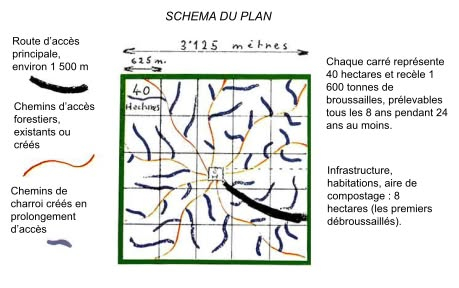
A main access road of approximately 1,500 m, existing or new forest tracks, and extraction paths as extensions — ensuring every zone is accessible.
Each 625 m square concentrates the harvest and processing. The 8-hectare central infrastructure accommodates composting areas and equipment.
Each unit is cleared then left to regrow for 8 years. The cycle repeats 3 times over 24 years — the forest does not burn, and the resource renews itself. In the interval, plots left to regrowth provide ideal conditions for biodiversity.
Scrubland chipped in situ continuously feeds the composting areas: the chips produced can be sold, or used directly by whoever is responsible for the clearance — balancing the financial equation.
This plan was visionary in 1975. It remains perfectly applicable today, with one decisive advantage Jean Pain did not yet have: mechanised equipment that increases the rate of work and reduces both labour costs and physical hardship.
From plan to practice — the Larzac example
What Jean Pain described as a project for manual organisation, today's equipment allows to mechanise and multiply in efficiency. On the southern Larzac plateau, the company BUXOR operates two mechanised teams that perfectly illustrate this. Each combines a Super-Pain chipper with a Mecalac excavator fitted with a pruning shear — each element bringing its own specific value to the clearance operation.
The compact design of the Mecalac made it Buxor's choice for carrying the pruning shear alongside the chipper. Capable of operating equally in forward or reverse, its unique boom kinematics offer exceptional manoeuvrability and 360° slewing capability — minimising impact on the habitat being worked.
Used for ditch maintenance in northern European countries, it is a selective harvesting tool that would have delighted Jean Pain: in the hands of a skilled operator, it reproduces the "human hand" and can cut branches, bushes and shrubs with precision, without destroying the surrounding habitat.
The essential component for valorising the scrubland! Hitched behind a Mecalac or on an independent chassis fitted with a chip reservoir, it follows the harvesting tool and stores the finished product before returning to the composting base.
These teams operate in several complementary contexts: wildfire prevention, opening up pastoral environments for extensive livestock farming, and control of the Box Tree Moth, a pest that destroys boxwood stands and thereby weakens slopes, increasing both erosion and fire risk.
Intervene briefly, intervene at the right time
Clearance, even preventive, represents a disturbance to wildlife. The rule is simple: the shorter the intervention, the less disturbing it is. This is where the efficiency of powerful mechanised equipment makes all the difference: a site completed in a few hours with a chipper suited to the zone disturbs wildlife far less than a manual site spread over several days.
The timing of intervention is equally important. Clearance must be carried out outside nesting periods (generally March to July) and ideally in autumn or winter, when wildlife is less active and vegetation better suited to cutting.
For operations in sensitive areas, an intermediate-sized chipper — Super-Pain 600 or 900 — is preferable to a very large model. The more compact machine offers better manoeuvrability on difficult terrain, and its smaller footprint limits soil compaction and damage to surrounding vegetation.
Prevention starts with the right tool
Whether you own a plot in a fire-risk zone or manage large forest areas, our Super-Pain chippers turn clearance from a costly constraint into a productive operation — built in France since 1981.