Drying wood chips through fermentation
Chip green, allow a few weeks of fermentation, obtain dry chips ready for the boiler — with no dryer, no extra energy. Natural fermentation of the chip heap does the work, and can even be taken further to produce heat and a soil amendment following the Jean Pain Method.
Fermentation as a natural dryer
When woody plants are chipped and stacked in a heap, fermentation begins naturally. This fermentation generates a significant rise in temperature — up to 70–80 °C at the core of the heap, due to intense bacterial activity. Not only does this heat help drive out moisture, but the bacteria responsible for the fermentation actually consume water to live. This is how green wood chips can be dried quickly, making them suitable for use in an automatic boiler without resort to other drying methods — such as the long wait required when drying logs.
This technique offers both a time advantage — you can chip immediately after felling without waiting for the wood to dry in log form, which can take months or even years — and a practical advantage, since chipping green wood requires less power and generates less noise, dust and equipment wear than chipping dry wood. It also allows the whole tree to be valorised, from trunk to branch tips.
The fermentation drying protocol
To achieve good results, a few simple rules must be followed during harvesting and storage.
-
1Chip immediately after felling
It is essential to chip the wood as quickly as possible after felling — ideally cutting and chipping in a continuous operation. This clears the working area for greater safety, avoids tangles of branches that complicate chipping, and above all allows fermentation to begin immediately and vigorously on freshly cut material.
-
2Store at 1 metre height for 1 month
During the active fermentation phase, the heap height must be kept to approximately 1 metre. If the heap is too large, the heat produced at the core — which can reach 70–80 °C — can cause internal charring and material loss, among other problems. A height-limited heap avoids this runaway effect and delivers optimal drying.
-
3After one month: build the permanent storage heap
After one month, active fermentation slows and the temperature drops. The chips can then be re-stacked to much greater heights, with no risk of charring. The slower fermentation that continues gradually dries the chips further, until a moisture content below 20% is achieved in three to five months.
For fermentation to dry the chips effectively, the heap must be stored sheltered from rain. However, the heap also needs to breathe, which is why we advise against using a tarpaulin — it generates condensation. An open-sided shelter or lean-to is ideal.
Granulometry and drying quality
Chip granulometry is doubly critical in this process: it determines both the quality of fermentation drying, and the performance of subsequent use in an automatic boiler.
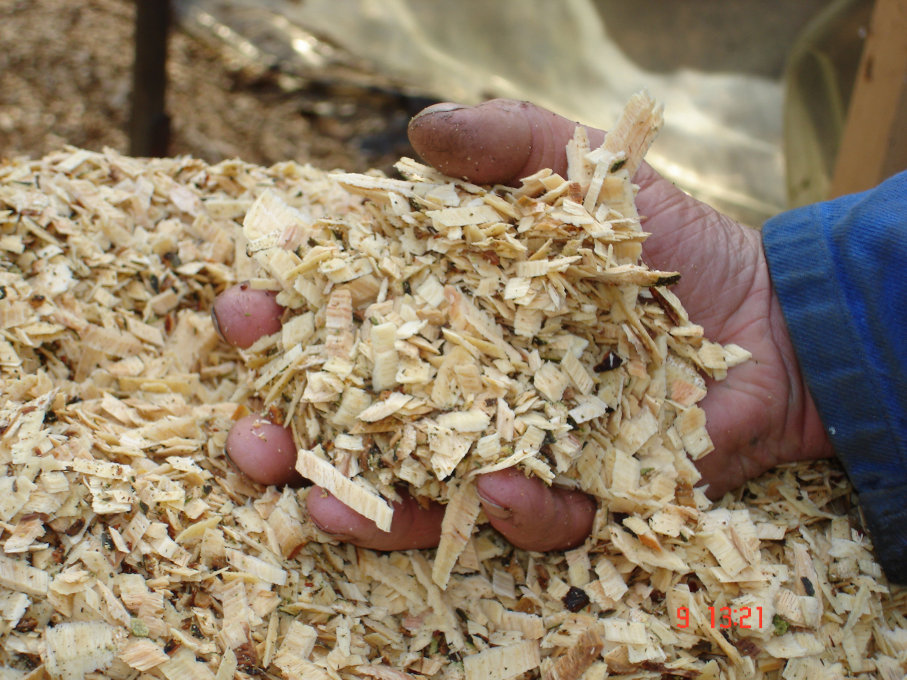
A consistent chip dries evenly throughout the heap. Large fragments slow the process and maintain moist pockets that compromise storage quality.
The short fibre of Super-Pain chips offers a greater contact surface for micro-organisms — activating rapid and even fermentation from the very first days.
The absence of large fragments reduces the load on the feed auger gearboxes of automatic boilers — limiting premature wear, excess electricity consumption and jam risk.
Super-Pain chips are directly usable straight from the chipper — with no screen or grid, no sorting or re-chipping step.
Ferment to dry, or ferment to heat?
The fermentation described above is a short, dry fermentation — the goal is to drive out moisture, for eventual use in a chip boiler. But the same reaction can be managed differently: by watering the heap regularly, fermentation is maintained over time and heat can be extracted by contact — hot water, greenhouse heating, etc — while simultaneously producing a high-value organic soil amendment.
This is the approach explored by Jean Pain from 1975 onwards, described in detail in The Methods of Jean Pain. The two uses are not mutually exclusive: the choice between them depends essentially on the volume of material available and the objective.
- Goal: dry chips for the boiler
- Duration: 3–5 months to reach < 20% moisture
- Sheltered storage, no watering
- Possible with small volumes
- No heat recovery, no soil amendment
- Dual output: usable heat + organic soil amendment
- Duration: up to 18 months at stable temperature
- Regular watering to maintain active fermentation
- Requires large volumes of material
- Heat recovery installation required
Chip quality — from the moment of chipping
Whether you are targeting fermentation drying, an automatic boiler, or any other application, our Super-Pain chippers produce the ideal chip — consistent, short fibre, no screening or re-chipping. Built in France since 1981.